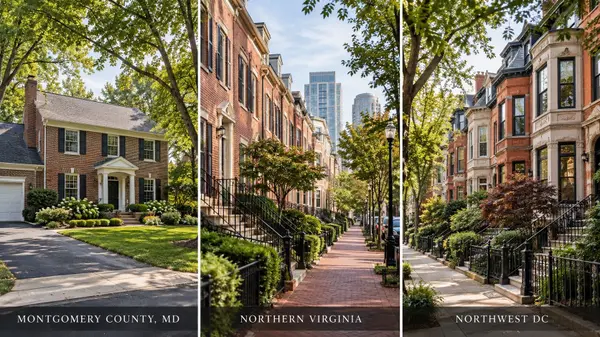

2026 Edition: The Ultimate Tax Showdown: Buying in DC vs. Maryland vs. Northern Virginia

TLDR
- Property taxes are lowest on average in Virginia, but Fairfax trends higher.
- DC transfer tax is higher at closing, offset by strong buyer programs like HPAP.
- Maryland’s income tax can be lower than DC for many buyers, with solid credits.
- Market inventory is improving, so compare tax impacts with rate trends carefully.
What does the tax picture really mean for DC-area buyers?
When clients ask me whether to buy in DC, Maryland, or Northern Virginia, they usually mean one thing: where will my long-term costs be lowest without sacrificing lifestyle. Taxes are a big part of that answer. The mix of property tax, income tax, and transfer costs at closing looks very different across jurisdictions. Your total cost can swing thousands per year based on where you buy.
On the market front, inventory and pricing trends shape how aggressively you can shop. In DC, regional MLS data has shown inventory rising roughly 25% year over year this spring while median prices still nudged higher. In Northern Virginia, active listings in late 2025 were up 45.1% year over year with a median sold price of $740,000, according to NVAR’s market comparison. Mortgage rates have hovered near 6.8 to 7 percent this year per FRED’s 30-year series, making tax efficiency even more important.
Here is how I define it as Kelly Jackson:
- Focus on recurring costs first - property tax and income tax - then closing taxes.
- Model your 5-year cost of ownership in at least two target areas before touring.
- Layer in commute, schools, HOA or condo fees, and likely appreciation by neighborhood.
How do property, income, and transfer taxes compare across DC, Maryland, and Virginia?
Start with the big three. Property tax is the annual cost tied to assessed value. Income tax hits your paycheck and matters if you live in DC. Transfer or recordation taxes hit primarily at closing and vary by jurisdiction.
For property taxes, the averages are competitive but not identical. DC’s effective rate is near 0.85 percent of assessed value. Maryland averages roughly 1.05 percent, with Montgomery County near 0.97 percent and Prince George’s County around 0.85 percent. Virginia averages approximately 0.82 percent, with Fairfax County near 0.99 percent and Loudoun County about 0.74 percent. You can review local policy and definitions at the DC Office of Tax and Revenue, the Maryland Department of Assessments and Taxation, and the Virginia Department of Taxation.
On income taxes, DC’s top bracket reaches 10.75 percent. Maryland’s top state rate is 5.75 percent plus a local rate that varies by county. Virginia’s top rate is 5.75 percent. For many mid-to-upper income households, Virginia often lands lower than DC, while Maryland varies depending on county add-ons. This is a key factor for remote workers or buyers who can live anywhere in the region.
Transfer and recordation costs are felt at closing. The transfer portion generally runs near 1.1 percent in DC, roughly 1 percent in Maryland, and around 0.5 percent in Virginia. Counties layer in their own recordation components, so your total closing taxes will vary. Budget conservatively and confirm your exact figures with me as we structure your offer and lender estimates.
Where do credits and exemptions help?
- DC offers homestead deductions and senior or disability credits that reduce taxable value. See DC programs via OTR.
- Maryland offers homestead credits and targeted exemptions administered by SDAT. Review options at MD SDAT.
- Virginia’s localities can provide senior or disabled tax relief, often called Circuit Breaker programs. Check details through the Virginia Department of Taxation and your county.
What do current market numbers suggest?
- In DC, lower months of supply for entry and mid-range homes has kept competition noticeable. Bright MLS’s Home Demand Index shows stronger demand in entry and single-family segments than in luxury condos.
- Northern Virginia’s inventory improved late in 2025, but prices still advanced. See NVAR’s November comparison for active listings up 45.1 percent year over year and a median of $740,000.
What are the pros and cons of DC, Maryland, and Northern Virginia?
Pros:
- DC: Walkability, services, and robust buyer assistance like HPAP.
- Maryland: Homestead protections and varied price points in PG and Montgomery.
- Virginia: Often lower income tax and competitive property tax averages.
Cons:
- DC: Higher transfer costs at closing and condo fees in core neighborhoods.
- Maryland: Some counties’ local income tax add-ons raise annual cost of living.
- Virginia: Fairfax property tax rate is higher than Loudoun and can impact carrying costs.
How do I run an apples-to-apples comparison and plan my timeline?
Start with price, property tax, and income tax, then add closing costs. Use realistic assumptions and your actual income bracket.
- DC example
- Northern Virginia example
- Maryland example
One of my clients purchased a two-bedroom condo in Arlington with a conventional loan, then layered in Virginia Housing education and a small down payment assistance option to keep cash at closing manageable. The lower income tax relative to DC helped their annual budget, and HOA fees were moderate for a full-amenity building.
Another client, a retiree couple, sold a rental property and bought a single-family home in Bowie around $420,000. Using the Maryland Mortgage Program, we reduced their out-of-pocket costs and leveraged PG County’s favorable property tax relative to many DC neighborhoods. The result was a predictable payment and space for visiting grandkids.
As you compare, keep market pace in mind. The DC area still sees segmented competition. Bright MLS’s Home Demand Index shows tighter conditions for entry-level homes than luxury condos. In Northern Virginia, late-2025 inventory improved substantially per NVAR, which can ease contingency timelines and reduce bidding stress.
FAQs
1) Should I wait for prices to drop before buying in 2025? Local data shows moderate price resilience despite rising inventory. Northern Virginia’s median was $740,000 in November 2025 with active listings up 45.1 percent year over year per NVAR. Nationally, existing-home prices in early 2025 rose about 4.8 percent year over year, according to NVAR’s national report. If affordability works and you find the right fit, time in the market often beats timing the market.
2) Are property taxes significantly lower in Virginia than Maryland or DC? On average, Virginia’s property tax rates are modest relative to DC and Maryland. That said, Fairfax County runs near 0.99 percent, which can be higher than parts of DC and PG County. Loudoun County, closer to 0.74 percent, can offer savings. Always calculate the annual tax based on assessed value and neighborhood rate, not just statewide averages.
3) How much should I budget for closing taxes and fees in each jurisdiction? In DC, budget for the transfer and recordation portions, with the transfer component near 1.1 percent. Maryland’s transfer portion is around 1 percent, and Virginia’s is closer to 0.5 percent. Lender fees, title charges, and prepaids add to total costs. I provide a customized estimate once we target a specific property and county, so you are never surprised at the closing table.
4) Do homestead and senior credits make a big difference long term? They can, especially if you plan to hold the home for many years. DC homestead deductions reduce taxable value, and senior or disability credits may provide additional relief. Maryland’s homestead credit protects against large assessment spikes, and Virginia localities offer senior or disabled relief. Over a decade, these programs can save thousands. Always verify your eligibility early in the process.
5) How do mortgage rates interact with taxes when I compare areas? Rates drive your principal and interest payment, while taxes shift your escrow. If rates are 6.8 to 7 percent per FRED, the monthly mortgage remains the biggest line item. However, a 0.2 to 0.3 percent difference in property tax can still mean $100 to $200 per month on a higher-priced home. Evaluate both together on a 5-year and 10-year horizon.
6) What is the best area for first-time buyers balancing taxes and price? PG County offers approachable prices with favorable property tax relative to many DC zip codes. Northern Virginia’s condos in Ballston or West Falls Church can be a strong entry with lower income tax compared to DC. In DC, HPAP can offset higher closing costs for eligible buyers. The best answer depends on your commute, lifestyle, and how long you plan to hold.
7) Where can I track market conditions while I shop? Use local association and MLS-backed resources. For Northern Virginia, check NVAR’s monthly reports. For DC demand by segment, review the Bright MLS Home Demand Index. For mortgage trends, follow FRED’s 30-year series. These sources help you align your offer strategy with real-time conditions.
Conclusion
The bottom line Your best choice across DC, Maryland, and Northern Virginia depends on how property tax, income tax, and closing taxes interact with your lifestyle and price point. DC delivers walkability and strong buyer assistance, Maryland balances value and credits across diverse suburbs, and Virginia often wins on income tax and property tax averages, especially outside Fairfax. Pair these tax realities with today’s improving inventory and rate environment to find a smart, sustainable path to ownership. I am here to model your 5-year and 10-year costs by neighborhood, then craft a winning plan from pre-approval to keys.
Categories
- All Blogs (116)
- Affordability and Cost of Living (13)
- Andrews Air Force Base (3)
- Arlington VA Real Estate (2)
- AS IS Home Sale (3)
- Baltimore County Real Estate (1)
- Baltimore Homes (2)
- Baltimore Real Estate (2)
- Buyer Education (5)
- Buyer Guides (16)
- Buyer Representation (2)
- Buyer Resources (4)
- Buyer Strategy (11)
- buying a home (8)
- Buying a Home Near DC (6)
- Camp Springs Real Estate (1)
- Capitol Hill DC (4)
- Charles County MD (4)
- Charles County Real Estate (4)
- College Housing Strategy (1)
- Condo & Co-op Living (2)
- Condo Living (5)
- DC Commute Times (2)
- DC Home Values (8)
- DC Market Trends (7)
- DC Neighborhood Insights (10)
- DC Neighborhoods (12)
- DC Real Estate Market (26)
- DC Relocation (6)
- DC Waterfront (1)
- DMV Buyer Strategy (9)
- DMV HOAs (3)
- DMV Housing Market (6)
- DMV Market Guides (2)
- DMV Neighborhoods (7)
- dmv real estate (25)
- Dumfries VA Real Estate (2)
- Expired Listings (1)
- Fairfax County Real Estate (3)
- Financing & Mortgage Guidance (1)
- First Time Home Buyers (4)
- Fort Belvoir (1)
- Fort Detrick Military Relocation (5)
- Fort Detrick PCS (5)
- Fort Washington MD (2)
- Fort Washington MD Real Estate (1)
- Frederick County Real Estate (3)
- Georgetown DC Realty Estate (2)
- Historic DC Communities (1)
- Home Buying Advice (4)
- Home Buying Education (2)
- Home Buying in Washington DC (8)
- Home Buying Strategies (2)
- Home Buying Tips (2)
- Home Improvement ROI (2)
- Home Prep (1)
- Home Preparation for Selling (1)
- Home Selling Advice (11)
- Home Selling in Washington DC (14)
- Home Selling Process (2)
- Home Selling Strategy (8)
- Home Selling Timelines (5)
- Home Value & Pricing (1)
- Home Value Pricing & Strategy (1)
- Home Value Trends and Forecast (1)
- House Hacking & Investment (1)
- Investor Education (1)
- Local Market Insights (2)
- Luxury Adjacent Homes (1)
- Luxury Home Selling (1)
- Market Conditions (1)
- Maryland Communities (10)
- Maryland Home Buyers (15)
- Maryland Home Sellers (17)
- Maryland Home Values (1)
- Maryland Homeowners (5)
- Maryland Neighborhoods (11)
- Maryland Real Estate (31)
- Montgomery County MD (10)
- Montgomery County MD Housing Market (7)
- Mortgage and Financing (2)
- National Harbor MD (1)
- Neighborhood Guides (8)
- Net Out Sheet (1)
- New Construction Homes (1)
- Northern VA Home Buyers (18)
- Northern Virginia Buyers (15)
- Northern Virginia Home Sellers (23)
- Northern Virginia Real Estate (36)
- Oxon Hill MD (1)
- PCS Housing Guide (5)
- Petworth DC Home Prices (1)
- Petworth DC Real Estate (2)
- PG County Real Estate (6)
- Prince George’s County Real Estate (11)
- Prince William County Real Estate (5)
- Real Estate Advice (2)
- Real Estate Closings (1)
- Real Estate Contracts (1)
- Real Estate Market Insights (4)
- Real Estate Negotiation and Strategy (2)
- Real Estate Strategies for Home Sellers (9)
- Reat Estate Strategy for Sellers (7)
- Relocation & Moving to Northern Virginia (17)
- Relocation and Military Housing (17)
- Rockville MD Real Estate (1)
- Sell Maryland Home (7)
- Seller Education (14)
- Seller Resources (7)
- Seller Strategy (14)
- Seller Success Stories (1)
- Silver Spring Real Estate (3)
- Smart Buying Strategies (2)
- Southern MD Real Estate (2)
- Stafford County Real Estate (3)
- student loans (1)
- Triangle VA Real Estate (1)
- USDA Loans DMV (1)
- VA Home Loans (2)
- VA Loan Purchase (2)
- VA Market Insights and Trends (4)
- Virginia Home Selling Guide (3)
- Washington DC Real Estate (20)
- Washington DC Sellers (8)
- Wealth Building (1)
- Where to Live in Northern Virginia (8)
- Woodmore MD (1)
- Zero Down Payment Programs (1)
Recent Posts