
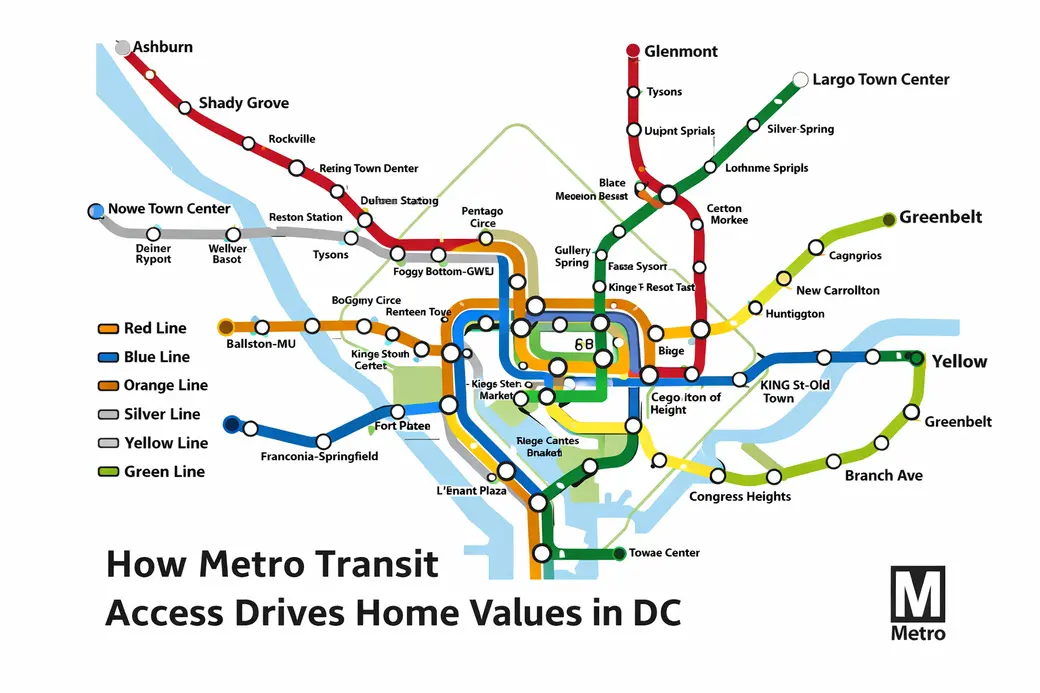
How Metro Transit Access Drives Home Value in DC
TLDR / Key Takeaways
Living near a Metro station in the DC Metro Area generally increases home value, but the impact depends on distance, price point, and neighborhood context. Homes within walking distance often command a measurable premium, while luxury properties may prioritize privacy over transit access. Understanding these nuances can significantly affect buying and selling outcomes.
Why Metro Access Matters in the DMV Housing Market
If you are buying or selling in Washington DC, Maryland, or Northern Virginia, one of the most common questions is whether Metro access actually increases home value.
The short answer is yes. Proximity to a Metrorail station is one of the most consistent drivers of property appreciation in the region. However, not all proximity is created equal. The value impact depends on how close the home is to the station, the price tier of the property, and the specific Metro line serving the area.
This guide breaks down how Metro access impacts your bottom line heading into 2026.
How Metro Proximity Affects Home Value
Metro access creates value because it reduces commute friction in one of the most traffic-congested regions in the country. Buyers consistently pay more for homes that allow them to commute without relying on a car.
That said, the premium follows a curve, not a straight line.
The Metro Radius Rule Explained
Homes Within 0.25 Miles of a Metro Station
Homes located within roughly a five-minute walk of a Metro station typically sell for a premium of 8.6 percent to 14 percent compared to similar homes located more than a mile away. For a median-priced DC home, this often translates to an additional 40,000 to 60,000 dollars in value.
Homes 0.25 to 0.5 Miles Away
This range is often referred to as the “Goldilocks Zone.” Homes within a ten-minute walk tend to capture a premium of approximately 7.5 percent. Buyers enjoy the convenience of Metro access without the drawbacks of station noise or heavy foot traffic.
Homes 0.5 to 1 Mile Away
Once a home is more than a half-mile from a station, the value premium drops sharply to around 3.9 percent. At this distance, most buyers no longer perceive the walk as convenient, particularly during extreme weather or late hours.
The Luxury Paradox: When Metro Access Matters Less
The Metro premium is strongest in the mid-market segment, particularly for condos, townhomes, and single-family homes priced between 400,000 and 800,000 dollars.
For ultra-luxury properties, typically those priced above 2 million dollars, the effect is negligible and can even turn negative. High-net-worth buyers often prioritize privacy, lot size, security, and exclusivity over proximity to public transit.
Neighborhoods such as the Palisades and Foxhall Crescent / Foxhall Village exemplify this dynamic. Buyers in these areas are far less concerned with Metro access and more focused on discretion and separation from density.
Where Metro Access Drives the Most Value
Clarendon and Ballston (Orange and Silver Lines)
The Rosslyn Ballston Corridor is a textbook example of transit-oriented development. Condos and townhomes here hold value exceptionally well due to direct Metro access and seamless commutes into downtown DC and K Street.
NoMa and Navy Yard (Red and Green Lines)
Both neighborhoods underwent dramatic transformation largely because of Metro accessibility. What were once industrial zones are now dense residential and mixed-use communities anchored by transit.
Capitol Hill (Blue, Orange, and Silver Lines)
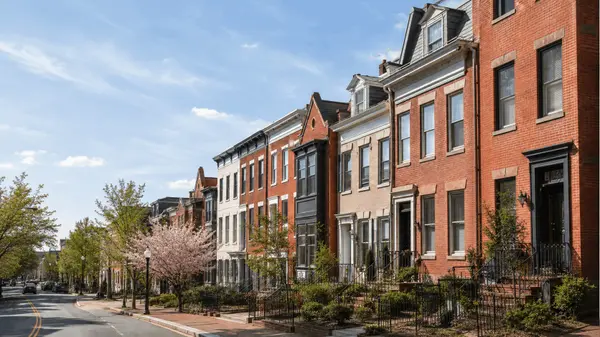
Historic rowhomes within walking distance of Eastern Market or Potomac Avenue stations command higher prices per square foot than similar homes farther east that rely more heavily on buses or the streetcar.
Looking Ahead: Future Transit and Appreciation
Smart buyers and investors look beyond where the Metro is today and focus on where transit investment is expanding.
Silver Line Extension
The extension into Reston and Ashburn has already been priced into many transactions, but it continues to support long-term value stability in these areas.
Purple Line in Maryland
While not a heavy rail system, the Purple Line is expected to create new appreciation pockets in places like Silver Spring, College Park, and New Carrollton by improving east-west connectivity.
What This Means for Buyers
Buyers should not assume that closer is always better. The highest value is often found two to three blocks from a station rather than directly adjacent to the tracks. Understanding noise patterns, above-ground sections, and pedestrian traffic can prevent overpaying.
For investors and condo buyers, Metro proximity remains one of the most reliable drivers of rental demand and lower vacancy rates.
Want to see how this plays out in real listings? View current homes across the DMV and compare neighborhoods, pricing, and transit access.
What This Means for Sellers
For sellers, Metro access must be positioned correctly. Homes within the optimal walking radius should highlight transit convenience, while luxury properties should emphasize privacy and lifestyle rather than proximity to public transportation.
Pricing strategy should reflect where the home falls on the Metro proximity curve, not just the presence of a station nearby.
Common Mistakes Buyers and Sellers Make
Many buyers overpay for homes directly adjacent to stations without accounting for noise or foot traffic. Others undervalue properties that fall just inside the optimal walking radius.
Sellers often assume Metro access automatically adds value at all price points, which can lead to mispricing in luxury segments.
Frequently Asked Questions About Buying Near the DC Metro
Is it loud living next to a Metro station
It can be. Homes that back up to above-ground tracks, such as portions of the Red Line in Brookland or Takoma, often sell at a discount due to noise. The strongest value is typically two to three blocks away.
Does Metro access matter more than bus access
Yes. High-frequency bus routes add convenience, but they do not create the same fixed-asset value impact as a heavy rail Metro station.
Is buying near a Metro station a good investment
Generally yes. Rental properties near Metro stations tend to experience lower vacancy rates and stronger long-term demand, particularly from government workers, young professionals, and students.
Does every Metro line add the same value
No. Lines with strong job center access and higher frequency service tend to create stronger premiums than peripheral or less connected lines.
Should luxury buyers care about Metro access
Typically no. Luxury buyers often prioritize privacy, security, and space over transit convenience.
If you are buying or selling in the DMV and want clarity based on local conditions, a short strategy call can help you avoid costly mistakes and identify the right approach for your situation.
Final Thoughts
Metro access remains one of the most powerful drivers of home value in the DMV, but only when understood correctly. Distance, price tier, and neighborhood context matter far more than simply being “near a station.”
Whether you are buying a rowhome in Capitol Hill, a condo along the Green Line, or evaluating a luxury property in Northwest DC, understanding how transit access truly impacts value can save you money or significantly increase your return.
If you are navigating a purchase or sale in the DMV and want clarity on how Metro access affects your specific property or target neighborhood, a short strategy conversation can help you make the right move with confidence.
Written by Kelly Jackson, a Washington DC real estate professional serving DC, Maryland, and Northern Virginia.
Categories
- All Blogs (114)
- Affordability and Cost of Living (13)
- Andrews Air Force Base (3)
- AS IS Home Sale (3)
- Baltimore County Real Estate (1)
- Baltimore Homes (2)
- Baltimore Real Estate (2)
- Buyer Education (5)
- Buyer Guides (16)
- Buyer Representation (2)
- Buyer Resources (4)
- Buyer Strategy (11)
- buying a home (8)
- Buying a Home Near DC (6)
- Camp Springs Real Estate (1)
- Capitol Hill DC (4)
- Charles County MD (4)
- Charles County Real Estate (4)
- College Housing Strategy (1)
- Condo & Co-op Living (2)
- Condo Living (5)
- DC Commute Times (2)
- DC Home Values (7)
- DC Market Trends (7)
- DC Neighborhood Insights (9)
- DC Neighborhoods (12)
- DC Real Estate Market (25)
- DC Relocation (6)
- DC Waterfront (1)
- DMV Buyer Strategy (9)
- DMV HOAs (3)
- DMV Housing Market (6)
- DMV Market Guides (2)
- DMV Neighborhoods (7)
- dmv real estate (24)
- Dumfries VA Real Estate (2)
- Expired Listings (1)
- Fairfax County Real Estate (2)
- Financing & Mortgage Guidance (1)
- First Time Home Buyers (4)
- Fort Belvoir (1)
- Fort Detrick Military Relocation (5)
- Fort Detrick PCS (5)
- Fort Washington MD (2)
- Fort Washington MD Real Estate (1)
- Frederick County Real Estate (3)
- Georgetown DC Realty Estate (1)
- Historic DC Communities (1)
- Home Buying Advice (4)
- Home Buying Education (2)
- Home Buying in Washington DC (8)
- Home Buying Strategies (2)
- Home Buying Tips (2)
- Home Improvement ROI (2)
- Home Prep (1)
- Home Preparation for Selling (1)
- Home Selling Advice (11)
- Home Selling in Washington DC (14)
- Home Selling Process (2)
- Home Selling Strategy (8)
- Home Selling Timelines (5)
- Home Value & Pricing (1)
- Home Value Pricing & Strategy (1)
- Home Value Trends and Forecast (1)
- House Hacking & Investment (1)
- Investor Education (1)
- Local Market Insights (2)
- Luxury Adjacent Homes (1)
- Luxury Home Selling (1)
- Market Conditions (1)
- Maryland Communities (10)
- Maryland Home Buyers (15)
- Maryland Home Sellers (17)
- Maryland Home Values (1)
- Maryland Homeowners (5)
- Maryland Neighborhoods (11)
- Maryland Real Estate (30)
- Montgomery County MD (9)
- Montgomery County MD Housing Market (6)
- Mortgage and Financing (2)
- National Harbor MD (1)
- Neighborhood Guides (8)
- Net Out Sheet (1)
- New Construction Homes (1)
- Northern VA Home Buyers (17)
- Northern Virginia Buyers (15)
- Northern Virginia Home Sellers (23)
- Northern Virginia Real Estate (35)
- Oxon Hill MD (1)
- PCS Housing Guide (5)
- Petworth DC Home Prices (1)
- Petworth DC Real Estate (2)
- PG County Real Estate (6)
- Prince George’s County Real Estate (11)
- Prince William County Real Estate (5)
- Real Estate Advice (2)
- Real Estate Closings (1)
- Real Estate Contracts (1)
- Real Estate Market Insights (4)
- Real Estate Negotiation and Strategy (2)
- Real Estate Strategies for Home Sellers (9)
- Reat Estate Strategy for Sellers (7)
- Relocation & Moving to Northern Virginia (17)
- Relocation and Military Housing (17)
- Rockville MD Real Estate (1)
- Sell Maryland Home (7)
- Seller Education (14)
- Seller Resources (7)
- Seller Strategy (14)
- Seller Success Stories (1)
- Silver Spring Real Estate (2)
- Smart Buying Strategies (2)
- Southern MD Real Estate (2)
- Stafford County Real Estate (3)
- student loans (1)
- Triangle VA Real Estate (1)
- USDA Loans DMV (1)
- VA Home Loans (2)
- VA Loan Purchase (2)
- VA Market Insights and Trends (4)
- Virginia Home Selling Guide (3)
- Washington DC Real Estate (20)
- Washington DC Sellers (8)
- Wealth Building (1)
- Where to Live in Northern Virginia (8)
- Woodmore MD (1)
- Zero Down Payment Programs (1)
Recent Posts