
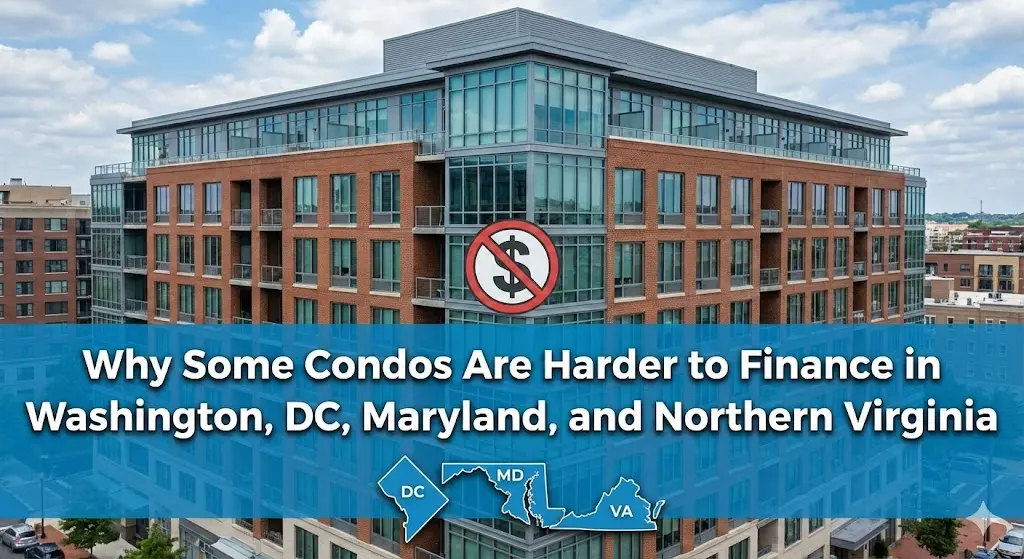
Why Some Condos Are Harder to Finance in Washington DC, Maryland, and Northern Virginia
TLDR
- Condo financing hinges on building health, reserves, owner-occupancy, litigation, and insurance readiness.
- Warrantable condos qualify for conventional loans; non-warrantable often require pricier portfolio loans.
- Neighborhood factors like mixed-use ratios and investor share can stall underwriting timelines.
- Preparation wins: preapproval, HOA review, reserves check, local first time home buyer programs.
What makes certain DMV condos harder to finance than others?
When a lender underwrites a condo, they are not only evaluating you. They are also underwriting the building. That second approval is where many deals in the District, Maryland, Northern Virginia, and Baltimore hit friction. Requirements center on the building’s reserves, insurance, owner-occupancy, delinquency rates, and any structural or legal red flags. If a project misses a key standard, conventional financing can stall and buyers may need a portfolio or non-QM option with higher costs.
Market context matters. According to regional MLS data and Bright MLS research, active listings in early 2025 ran nearly 30 percent above last year and months of supply moved toward 1.6. Condo inventory has been rising faster than single family in many close-in neighborhoods, which gives DC Area Home Buyer clients more choice but also more variance in building quality. Median prices in the metro hovered near the high five hundreds in late winter 2025, with Northern Virginia trending higher per NVAR statistics.
Here is how I define it as a Realtor specializing in condos:
- A harder-to-finance condo is one that fails a conventional “project approval” test.
- The issues most often involve reserves, litigation, insurance, or owner-occupancy.
- Solvable problems require time and documentation; chronic issues require alternate financing.
How do Fannie Mae and Freddie Mac rules shape condo financing here?
Most DMV condos are financed conventionally, which means they must meet Fannie Mae or Freddie Mac project standards. Typical thresholds include at least 50 percent owner-occupancy, no unresolved structural issues, no pending litigation that could affect safety or marketability, commercial space under roughly 35 percent, and adequate master insurance including flood or fidelity coverage if needed. Reserve funding is critical. Many lenders look for at least 10 percent of the annual budget allocated to reserves and less than 15 percent of owners delinquent on fees.
Buildings that do not meet these criteria are often labeled non-warrantable. That status does not mean you cannot buy, but it does mean the loan may be a portfolio product with a higher rate and larger down payment. The upcoming Fannie Mae condo project tool will make it easier for lenders to verify status, yet documentation still has to match reality on the ground.
Warrantable vs. non-warrantable basics
Warrantable means the project aligns with Fannie or Freddie guidelines so your loan can be sold to the agencies. Non-warrantable means it does not. In practice, I see non-warrantable projects in mixed-use developments with high commercial ratios, new or small buildings with thin reserves, or condo associations facing special assessments. Non-warrantable loans typically require 15 percent down, carry interest rates about 1 to 1.5 percent higher than conventional, and may ask for extra months of reserves.
Where do neighborhood factors cause financing friction around DC, MD, and VA?
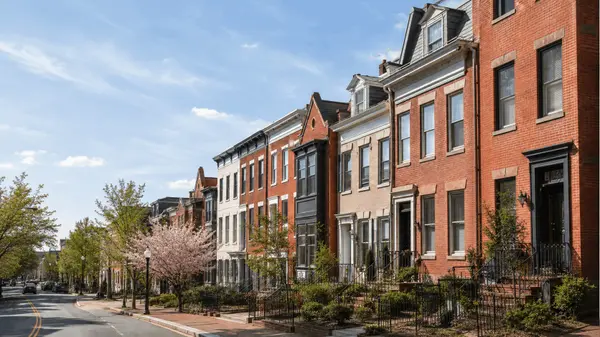
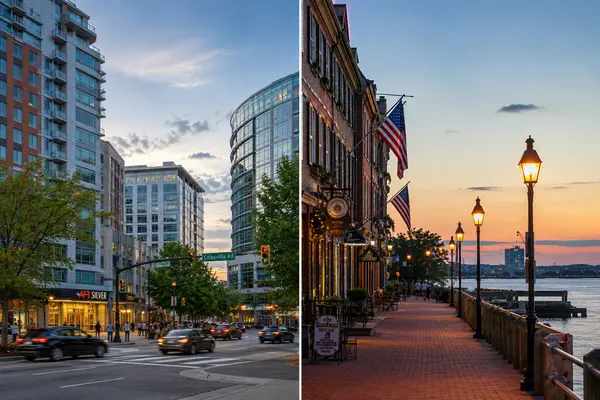
Neighborhood dynamics in Washington DC include a wide mix of boutique and full-service buildings. Each carries unique financing implications that I walk through at the first showing. Some examples include:
- Logan Circle
- Navy Yard and Capitol Riverfront
- Dupont Circle and West End
- Clarendon and Ballston in Arlington
- Bethesda and Downtown Silver Spring
Local context matters for value too. Median prices in Northern Virginia ran around the mid to high six hundreds in early 2025 per NVAR statistics, while District-wide medians trended around seven hundred thousand per MLS summaries. In a rising-inventory environment, I encourage DC Home Buyer clients to prioritize buildings with clean financials since resale values often outperform in projects with robust reserves.
What are the pros and cons of buying a condo with tighter financing?
Pros:
- Smaller buyer pool can mean better pricing and stronger negotiation leverage.
- Opportunity to buy into a great location while the association fixes solvable issues.
- Potential for outsized appreciation after reserves, insurance, or litigation are stabilized.
Cons:
- Higher interest rates and down payment if a portfolio or non-QM loan is required.
- Longer timelines for underwriting because the building review becomes more intensive.
- Resale pool may be limited until the building becomes warrantable again.
How do I structure my process, costs, and timeline to win on a tricky condo?
Preparation is everything. First, get a full preapproval from a lender that regularly finances DMV condos and performs in-house condo reviews. Ask your lender to preview the building with a preliminary questionnaire, master insurance certificate, and budget review. In DC, you have a 3-business-day right of rescission after receiving condo resale documents. In Maryland, you have 7 days. In Virginia, you have 3 days. Use that window to verify reserves and policies.
Typical costs to budget:
- Condo questionnaire and resale package: 150 to 400 dollars, rush fees 50 to 150 dollars
- Lender condo review fee: 200 to 500 dollars
- Appraisal: 600 to 850 dollars
- Master insurance addendums or flood certifications if applicable: 20 to 75 dollars
Timeline benchmarks I manage for clients:
- Lender preapproval: 24 to 48 hours with income and assets uploaded
- Appraisal ordered: within 48 hours of ratification
- Condo documents reviewed: within 3 to 5 days of delivery
- Clear-to-close: 25 to 35 days for warrantable; 30 to 45 days for non-warrantable
One of my clients purchased a one-bedroom in Navy Yard where the HOA had 12 percent reserves and no litigation. Because we verified the budget early and ordered the questionnaire at contract, underwriting cleared the project in five days and we closed in 28 days with a conventional 5 percent down loan.
Another client in Clarendon loved a mixed-use building with high retail square footage. The project missed the conventional commercial ratio. We pivoted to a portfolio product at 1.25 percent above conventional with 15 percent down. The seller contributed 10,000 dollars toward closing to offset the rate difference, and the buyer plans to refinance once the commercial component is reduced.
If you are leveraging first time home buyer programs, pair strategy with speed. DC Open Doors, the Maryland Mortgage Program, and Virginia Housing grants can reduce cash to close and strengthen your offer when paired with a local lender’s condo expertise. Learn more at:
- Bright MLS research
- NVAR statistics
- DC Open Doors
- Maryland Mortgage Program
- Virginia Housing
- FHFA House Price Index
FAQs
1) What makes a condo non-warrantable in the DMV? Common triggers include owner-occupancy below 50 percent, commercial space that is too high compared to residential, unresolved structural concerns, active litigation that could impact safety or value, inadequate master insurance, reserves under 10 percent of the annual budget, or more than 15 percent of owners behind on dues. Any one of these can block a conventional loan and push buyers toward portfolio financing with higher rates.
2) Are FHA or VA loans realistic for DC condos? Yes, but the pool is smaller than for conventional. FHA and VA approvals are building-specific and many associations are not on the active approval lists. FHA can be a great fit for first-time buyers if the building qualifies. Ask your lender to check the building’s status early and to verify owner-occupancy and insurance. If the building is not approved, plan for conventional or a portfolio alternative.
3) How much do HOA fees and reserves matter to lenders and value? Fees themselves are not disqualifying, but reserves and delinquency rates are. Lenders typically want to see at least 10 percent of the annual budget going to reserves and fewer than 15 percent of units delinquent. In practice, buildings with strong reserves handle maintenance without surprise assessments and often resell better. Monthly fees in many DC buildings run 400 to 600 dollars, which should be factored into affordability.
4) Can I use a portfolio or non-QM lender to get around building issues? Often, yes. Portfolio loans are held by the bank and can close on otherwise solid buildings that miss an agency guideline. Expect a higher rate, roughly 1 to 1.5 percent above conventional, and larger down payments around 15 percent. If the association resolves its issues later, you can often refinance into a conventional loan and recapture monthly savings.
5) How long does condo underwriting take in DC, Maryland, and Virginia? For warrantable projects with complete documents, plan 25 to 30 days to close. Non-warrantable or complex mixed-use projects can push timelines to 30 to 45 days. The biggest variable is speed of HOA response on resale packages, questionnaires, and insurance certificates. I order those immediately at contract and set title and appraisal within 48 hours to keep momentum.
6) What documents should I review before making an offer on a condo? At a minimum, review the most recent budget, reserve study or reserve disclosures, master insurance certificate, rules and regulations, meeting minutes, and any special assessment notices. Ask your lender to preview a condo questionnaire. In DC, you have 3 business days to cancel after receiving condo documents, Maryland grants 7 days, and Virginia allows 3 days, so structure your contingency to protect your deposit.
Conclusion
The bottom line Condo financing in the DMV is all about the health of the building. If reserves are strong, owner-occupancy is solid, and insurance is appropriate, your financing behaves like any single family purchase. If a project misses a key standard, you need a lender and agent who can navigate alternate options, timelines, and negotiation strategies. As your local guide near Dupont Circle, Logan Circle, West End, and Clarendon, I will get the facts early, align the loan to the building’s reality, and position you to close with confidence using the right combination of financing and first time home buyer programs.
Written by Kelly Jackson, a top 2% DMV Realtor with extensive knowledge of condo financing and condo related real estate.
Categories
- All Blogs (114)
- Affordability and Cost of Living (13)
- Andrews Air Force Base (3)
- AS IS Home Sale (3)
- Baltimore County Real Estate (1)
- Baltimore Homes (2)
- Baltimore Real Estate (2)
- Buyer Education (5)
- Buyer Guides (16)
- Buyer Representation (2)
- Buyer Resources (4)
- Buyer Strategy (11)
- buying a home (8)
- Buying a Home Near DC (6)
- Camp Springs Real Estate (1)
- Capitol Hill DC (4)
- Charles County MD (4)
- Charles County Real Estate (4)
- College Housing Strategy (1)
- Condo & Co-op Living (2)
- Condo Living (5)
- DC Commute Times (2)
- DC Home Values (7)
- DC Market Trends (7)
- DC Neighborhood Insights (9)
- DC Neighborhoods (12)
- DC Real Estate Market (25)
- DC Relocation (6)
- DC Waterfront (1)
- DMV Buyer Strategy (9)
- DMV HOAs (3)
- DMV Housing Market (6)
- DMV Market Guides (2)
- DMV Neighborhoods (7)
- dmv real estate (24)
- Dumfries VA Real Estate (2)
- Expired Listings (1)
- Fairfax County Real Estate (2)
- Financing & Mortgage Guidance (1)
- First Time Home Buyers (4)
- Fort Belvoir (1)
- Fort Detrick Military Relocation (5)
- Fort Detrick PCS (5)
- Fort Washington MD (2)
- Fort Washington MD Real Estate (1)
- Frederick County Real Estate (3)
- Georgetown DC Realty Estate (1)
- Historic DC Communities (1)
- Home Buying Advice (4)
- Home Buying Education (2)
- Home Buying in Washington DC (8)
- Home Buying Strategies (2)
- Home Buying Tips (2)
- Home Improvement ROI (2)
- Home Prep (1)
- Home Preparation for Selling (1)
- Home Selling Advice (11)
- Home Selling in Washington DC (14)
- Home Selling Process (2)
- Home Selling Strategy (8)
- Home Selling Timelines (5)
- Home Value & Pricing (1)
- Home Value Pricing & Strategy (1)
- Home Value Trends and Forecast (1)
- House Hacking & Investment (1)
- Investor Education (1)
- Local Market Insights (2)
- Luxury Adjacent Homes (1)
- Luxury Home Selling (1)
- Market Conditions (1)
- Maryland Communities (10)
- Maryland Home Buyers (15)
- Maryland Home Sellers (17)
- Maryland Home Values (1)
- Maryland Homeowners (5)
- Maryland Neighborhoods (11)
- Maryland Real Estate (30)
- Montgomery County MD (9)
- Montgomery County MD Housing Market (6)
- Mortgage and Financing (2)
- National Harbor MD (1)
- Neighborhood Guides (8)
- Net Out Sheet (1)
- New Construction Homes (1)
- Northern VA Home Buyers (17)
- Northern Virginia Buyers (15)
- Northern Virginia Home Sellers (23)
- Northern Virginia Real Estate (35)
- Oxon Hill MD (1)
- PCS Housing Guide (5)
- Petworth DC Home Prices (1)
- Petworth DC Real Estate (2)
- PG County Real Estate (6)
- Prince George’s County Real Estate (11)
- Prince William County Real Estate (5)
- Real Estate Advice (2)
- Real Estate Closings (1)
- Real Estate Contracts (1)
- Real Estate Market Insights (4)
- Real Estate Negotiation and Strategy (2)
- Real Estate Strategies for Home Sellers (9)
- Reat Estate Strategy for Sellers (7)
- Relocation & Moving to Northern Virginia (17)
- Relocation and Military Housing (17)
- Rockville MD Real Estate (1)
- Sell Maryland Home (7)
- Seller Education (14)
- Seller Resources (7)
- Seller Strategy (14)
- Seller Success Stories (1)
- Silver Spring Real Estate (2)
- Smart Buying Strategies (2)
- Southern MD Real Estate (2)
- Stafford County Real Estate (3)
- student loans (1)
- Triangle VA Real Estate (1)
- USDA Loans DMV (1)
- VA Home Loans (2)
- VA Loan Purchase (2)
- VA Market Insights and Trends (4)
- Virginia Home Selling Guide (3)
- Washington DC Real Estate (20)
- Washington DC Sellers (8)
- Wealth Building (1)
- Where to Live in Northern Virginia (8)
- Woodmore MD (1)
- Zero Down Payment Programs (1)
Recent Posts