
Why Your DC Area Home Isn't Selling (and What Actually Works)
Beyond the Hype: The DC Market's New Reality
If your home is sitting on the market in Washington DC, Prince George’s County, Montgomery County, or Northern Virginia, you are not dealing with bad luck or a broken market.
You are dealing with misalignment.
Despite what many homeowners are told, a “strong market” does not guarantee a sale. It guarantees results only for homes that are priced, positioned, and executed correctly. In today’s DMV market, buyers are informed, selective, and quick to dismiss homes that do not clearly stand out.
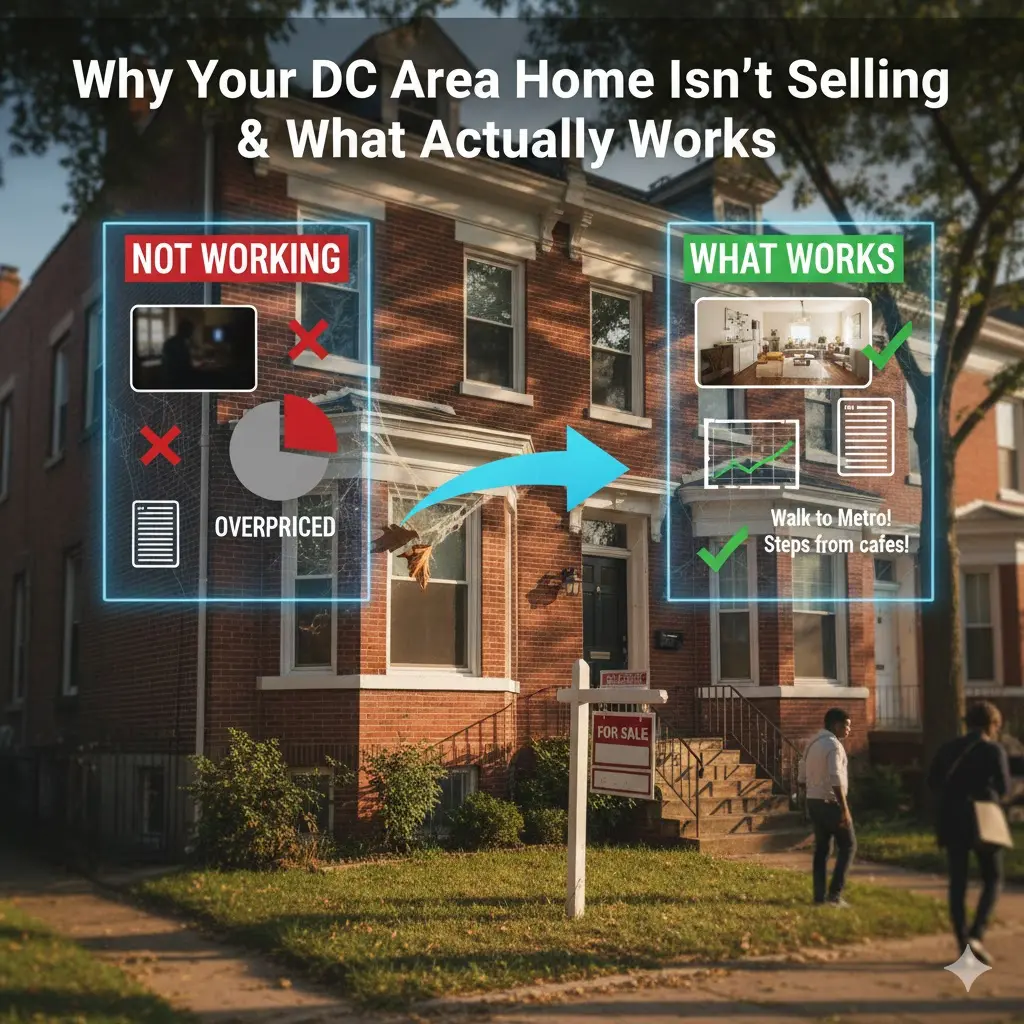
Homes do not fail to sell randomly. They stall for four specific reasons.
The DC Market Is Strong, But It Is Not Forgiving
A strong market rewards accuracy. It punishes hesitation.
Buyers today are comparing your home against multiple active alternatives. They are looking at price per square foot, condition, location, layout, and long term value. If your home does not clearly win within its competitive set, buyers do not negotiate. They move on.
This shift is why many sellers feel confused. The market headlines sound positive, yet showings slow and offers never materialize.
That disconnect has causes.
Overpricing Is Still the Number One Reason Homes Stall
Most stalled listings are not drastically overpriced. They are slightly overpriced.
That small gap is enough to push a home outside the most active buyer pool. The result is fewer showings early, longer days on market, and growing skepticism among buyers. Once a home lingers, buyers assume there is a problem even if none exists.
Later price reductions rarely recreate the urgency that correct pricing creates at launch. In the DC area, pricing must reflect current competition, not past sales alone.
Condition and Presentation Matter More Than Sellers Expect
Buyers today are less willing to take on visible work unless the price clearly compensates for it.
Dated kitchens, tired flooring, worn paint, or signs of deferred maintenance reduce perceived value immediately. Even well maintained homes can struggle if they feel dated compared to renovated alternatives in the same neighborhood.
Buyers do not price homes emotionally. They price risk and inconvenience. When presentation creates doubt, buyers either discount the home heavily or eliminate it entirely.
Exposure Does Not Sell Homes. Demand Does.
Many sellers are told their home is getting “great exposure.” Exposure is meaningless without urgency.
Professional photography, staging, pricing, and timing must work together to create momentum. When any of these elements is weak, the listing underperforms no matter how long it stays online.
The first two weeks on the market matter more than the next two months. That is when buyer attention is highest and price expectations are set.
Buyer Psychology Has Changed
Buyers are no longer willing to overpay simply to secure a home.
They expect transparency, clean disclosures, and pricing that reflects reality. When they sense resistance, uncertainty, or a seller anchored to yesterday’s peak prices, they disengage quietly.
Strong offers still happen. They happen when buyers feel confident, not pressured.
What Actually Works When a Home Isn’t Selling
Fixing a stalled listing is not about waiting longer or making small, reactive changes. It requires a deliberate reset.
Reassess the Market Honestly
The first step is understanding where the home truly sits today. That means comparing it to current active listings and recently accepted contracts, not just closed sales from months ago.
A proper reassessment answers three questions
What homes buyers are choosing instead
What those homes offer that yours does not
What price point actually triggers action in this segment
Without this clarity, any adjustment is guesswork.
Correct Pricing With Purpose
Small price reductions rarely work. They signal uncertainty and encourage buyers to wait.
When pricing needs to change, it must be meaningful enough to reposition the home into a new buyer pool. The goal is not to chase the market. The goal is to create urgency.
In the DC area, decisive pricing paired with a clear relaunch consistently outperforms gradual reductions.
Eliminate Presentation Friction
Buyers decide how they feel about a home within minutes.
Effective fixes often include targeted or virtual staging, improved lighting, neutralizing visual distractions, and addressing visible wear that suggests deferred maintenance. Updated photography is critical if the home’s condition or layout has changed.
If buyers must imagine improvement, the price must reflect that reality. If the price does not, presentation must.
Reframe the Listing Around Buyer Priorities
Most listings focus on features. Buyers care about outcomes.
A reset means rewriting the listing to address how the home fits a buyer’s life, what problem it solves, and why it is a better choice than the alternatives. This includes reordering photos, clarifying value drivers, and highlighting neighborhood advantages that matter to buyers today.
Generic descriptions do not convert. Clear positioning does.
Relaunch Instead of Letting the Listing Linger
A home that has stalled must be reintroduced to the market.
A proper relaunch combines updated pricing, refreshed visuals, and renewed exposure within a defined window. Buyers who passed earlier will only take a second look if the home clearly feels different.
Time alone does not reset perception. Strategy does.
Reduce Buyer Risk Before They Ask
Buyers hesitate when they sense uncertainty.
Proactive sellers reduce friction by addressing inspections, disclosures, HOA details, and known concerns upfront. When risk is reduced, confidence increases. Confident buyers act faster and negotiate less aggressively.
Align the Strategy With the Seller’s Real Goal
Some sellers want top dollar. Others need timing certainty or simplicity.
A strategy only works when it aligns with the seller’s true priority. When goals are unclear or conflicting, decisions become emotional and inconsistent and the market responds accordingly.
Clarity leads to clean execution.
Final Thought
If your DC area home is not selling, the market is not broken. The strategy is simply misaligned.
Homes that sell after sitting do so because the approach changed, not because time passed. Sellers who succeed today confront reality early, adjust decisively, and make it easy for buyers to say yes.
Ready for a Clear Answer?
If your home has been sitting and you want an honest assessment of why, I offer straightforward market diagnostics with no pressure and no generic advice.
If I can show you exactly what is holding your home back and what would realistically move it, you can decide your next step with clarity.
Call me or reach out directly for a private consultation.
The right strategy changes everything.
Categories
- All Blogs (114)
- Affordability and Cost of Living (13)
- Andrews Air Force Base (3)
- AS IS Home Sale (3)
- Baltimore County Real Estate (1)
- Baltimore Homes (2)
- Baltimore Real Estate (2)
- Buyer Education (5)
- Buyer Guides (16)
- Buyer Representation (2)
- Buyer Resources (4)
- Buyer Strategy (11)
- buying a home (8)
- Buying a Home Near DC (6)
- Camp Springs Real Estate (1)
- Capitol Hill DC (4)
- Charles County MD (4)
- Charles County Real Estate (4)
- College Housing Strategy (1)
- Condo & Co-op Living (2)
- Condo Living (5)
- DC Commute Times (2)
- DC Home Values (7)
- DC Market Trends (7)
- DC Neighborhood Insights (9)
- DC Neighborhoods (12)
- DC Real Estate Market (25)
- DC Relocation (6)
- DC Waterfront (1)
- DMV Buyer Strategy (9)
- DMV HOAs (3)
- DMV Housing Market (6)
- DMV Market Guides (2)
- DMV Neighborhoods (7)
- dmv real estate (24)
- Dumfries VA Real Estate (2)
- Expired Listings (1)
- Fairfax County Real Estate (2)
- Financing & Mortgage Guidance (1)
- First Time Home Buyers (4)
- Fort Belvoir (1)
- Fort Detrick Military Relocation (5)
- Fort Detrick PCS (5)
- Fort Washington MD (2)
- Fort Washington MD Real Estate (1)
- Frederick County Real Estate (3)
- Georgetown DC Realty Estate (1)
- Historic DC Communities (1)
- Home Buying Advice (4)
- Home Buying Education (2)
- Home Buying in Washington DC (8)
- Home Buying Strategies (2)
- Home Buying Tips (2)
- Home Improvement ROI (2)
- Home Prep (1)
- Home Preparation for Selling (1)
- Home Selling Advice (11)
- Home Selling in Washington DC (14)
- Home Selling Process (2)
- Home Selling Strategy (8)
- Home Selling Timelines (5)
- Home Value & Pricing (1)
- Home Value Pricing & Strategy (1)
- Home Value Trends and Forecast (1)
- House Hacking & Investment (1)
- Investor Education (1)
- Local Market Insights (2)
- Luxury Adjacent Homes (1)
- Luxury Home Selling (1)
- Market Conditions (1)
- Maryland Communities (10)
- Maryland Home Buyers (15)
- Maryland Home Sellers (17)
- Maryland Home Values (1)
- Maryland Homeowners (5)
- Maryland Neighborhoods (11)
- Maryland Real Estate (30)
- Montgomery County MD (9)
- Montgomery County MD Housing Market (6)
- Mortgage and Financing (2)
- National Harbor MD (1)
- Neighborhood Guides (8)
- Net Out Sheet (1)
- New Construction Homes (1)
- Northern VA Home Buyers (17)
- Northern Virginia Buyers (15)
- Northern Virginia Home Sellers (23)
- Northern Virginia Real Estate (35)
- Oxon Hill MD (1)
- PCS Housing Guide (5)
- Petworth DC Home Prices (1)
- Petworth DC Real Estate (2)
- PG County Real Estate (6)
- Prince George’s County Real Estate (11)
- Prince William County Real Estate (5)
- Real Estate Advice (2)
- Real Estate Closings (1)
- Real Estate Contracts (1)
- Real Estate Market Insights (4)
- Real Estate Negotiation and Strategy (2)
- Real Estate Strategies for Home Sellers (9)
- Reat Estate Strategy for Sellers (7)
- Relocation & Moving to Northern Virginia (17)
- Relocation and Military Housing (17)
- Rockville MD Real Estate (1)
- Sell Maryland Home (7)
- Seller Education (14)
- Seller Resources (7)
- Seller Strategy (14)
- Seller Success Stories (1)
- Silver Spring Real Estate (2)
- Smart Buying Strategies (2)
- Southern MD Real Estate (2)
- Stafford County Real Estate (3)
- student loans (1)
- Triangle VA Real Estate (1)
- USDA Loans DMV (1)
- VA Home Loans (2)
- VA Loan Purchase (2)
- VA Market Insights and Trends (4)
- Virginia Home Selling Guide (3)
- Washington DC Real Estate (20)
- Washington DC Sellers (8)
- Wealth Building (1)
- Where to Live in Northern Virginia (8)
- Woodmore MD (1)
- Zero Down Payment Programs (1)
Recent Posts